
Optimizing for early success in research
Lauren Smith
Jul 8, 2026
For a springboard to the forefront of process systems engineering, look no further than the fundamentals. “Learning the fundamentals sets you up to think big,” says Alexander Dowling (‘15). “It broadens and develops your curiosities.”
In the era of generative artificial intelligence, (AI) Qi Zhang (‘16) thinks that chemical engineering fundamentals are more important than ever. “Students and researchers at all levels need to be able to distinguish between right and wrong answers from generative AI, and you can only do that if you have enough fundamental knowledge,” he says.
As domain experts who can work with data and build models, Dowling and Zhang are among a new cadre of process systems engineers building on their Carnegie Mellon University education. The Computing & Systems Technology Division (CAST) of the American Institute of Chemical Engineers (AIChE) awarded its Outstanding Young Researcher Award to Dowling in 2025 and to Zhang in 2024.
The award recognizes outstanding contributions to the chemical engineering computing and systems technology literature. Five other CMU chemical engineering alumni have received the award in the past 13 years: Victor Zavala (2019), Fengqi You (2018), Carl Laird (2015), Christos Maravelias (2013), and Christopher Rao (2012).

Alexander Dowling earned his Ph.D. in 2015.
Alexander Dowling
Alexander Dowling’s research portfolio combines his undergraduate interest in applied statistics, his doctoral focus on detailed process modeling and optimization, and his postdoctoral work fitting flexible chemical manufacturing into wholesale energy markets.
“It’s been really fun to take the fundamentals that I learned at CMU and merge them with other passions to create a new research direction in optimal experiment design,” he says.
Dowling is the Tony and Sarah Earley Collegiate Professor of Energy and the Environment and Associate Professor of Chemical and Biomolecular Engineering at the University of Notre Dame. “Many a day still, I will look back and connect something I read in literature or hear at a talk to those fundamentals of process systems engineering,” he says.
To optimize design of experiments, Dowling builds and validates mathematical models and digital twins. At the heart of his work is an interest in helping people make better decisions. Colleagues use Dowling’s mathematical models to design better experiments for testing a scientific hypothesis; scale up a technology and de-risk it; or design energy systems and infrastructure.
Dowling got his start in process systems engineering working with Larry Biegler and the Center for Advanced Process Decision-making. He remembers Carnegie Mellon’s Department of Chemical Engineering as a great place to learn in community and has carried those lessons forward into his own teaching practice.
Dowling is a dedicated mentor for graduate students at the University of Notre Dame, where he has received two university-wide awards. Students nominated and selected him for the Mentoring Award from the Graduate Student Government in 2023. The James A. Burns, C.S.C., Award in 2025, which he received in 2025, recognized his outstanding faculty mentorship. Eleven of Dowling’s advisees have made promising starts at leading companies and research institutions, including Pfizer, Eli Lilly, and Amazon Research.
For Dowling, the Ph.D. program at Carnegie Mellon started more than his career. It’s also where he met his wife, then a master’s student in chemical engineering.
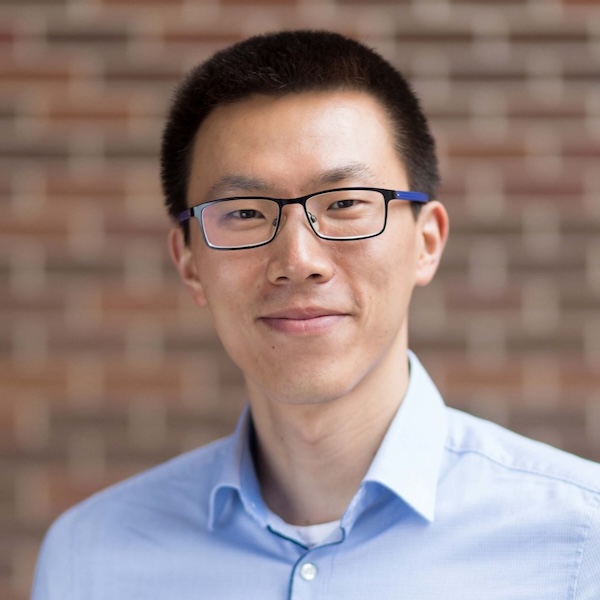
Qi Zhang earned his Ph.D. in 2016.
Qi Zhang
Qi Zhang develops computational tools for analyzing and optimizing complex systems. He is an Associate Professor and holder of the Amundson Chair in the Department of Chemical Engineering and Materials Science at the University of Minnesota.
Zhang’s computational methods can be used for a broad set of applications, and he currently focuses on three areas. The first is optimizing the design and operation of sustainable process systems. “In my research group, we’re thinking about new, more sustainable ways of manufacturing chemicals, and we’re addressing the systems-level challenges that come with that,” says Zhang.
Because the availability of renewable resources like solar and wind fluctuates over time, chemical plants must be run more dynamically. Zhang analyzes and optimizes problems like this at multiple spatial and temporal scales.
The second area to which Zhang applies his research is enterprise-wide optimization. Large chemical companies have very complex value chains of materials, manufacturing plants, and products. Since his doctoral work with CMU’s Professor of Chemical Engineering Ignacio Grossmann, Zhang examined how to coordinate actions within a complex supply chain using advanced computational optimization methods. In this context, he is also interested in how human users interact with these computational tools in practice and how modern artificial intelligence can help improve such human-computer collaboration.
Zhang also applies his methods at the cellular level. He is collaborating with bioengineering colleagues working on cell culture engineering. “It’s exciting to work on interdisciplinary problems that I alone cannot do,” he says. “These are very difficult and very different problems, but we can still formulate them as mathematical problems and apply our computational methods to solve them.”
Zhang is motivated to work on problems that have impact and value in the real world. He began his career as a conceptual process engineer at BASF. Since then, he has maintained strong ties with industry, including a longstanding collaboration with Dow, where he also spent six months as a visiting professor in 2025.
These experiences give Zhang a window to how companies work and the problems that are most relevant to industry. He brings this perspective into the classroom, following the example of many of his own undergraduate professors at RWTH Aachen (Germany), who would often share anecdotes informed by their many years of industry experience.
Zhang’s undergraduate studies were also the start of his path into process systems engineering. As an exchange student at Carnegie Mellon, he took a graduate-level process systems engineering course. Taught by Grossmann, it was Zhang’s first introduction to what is now his field of research.