
Smarter predictions for smokey skies
To understand precisely how smoke travels and affects the atmosphere, scientists need more accurate models.
Jul 15, 2026
Source: iStock
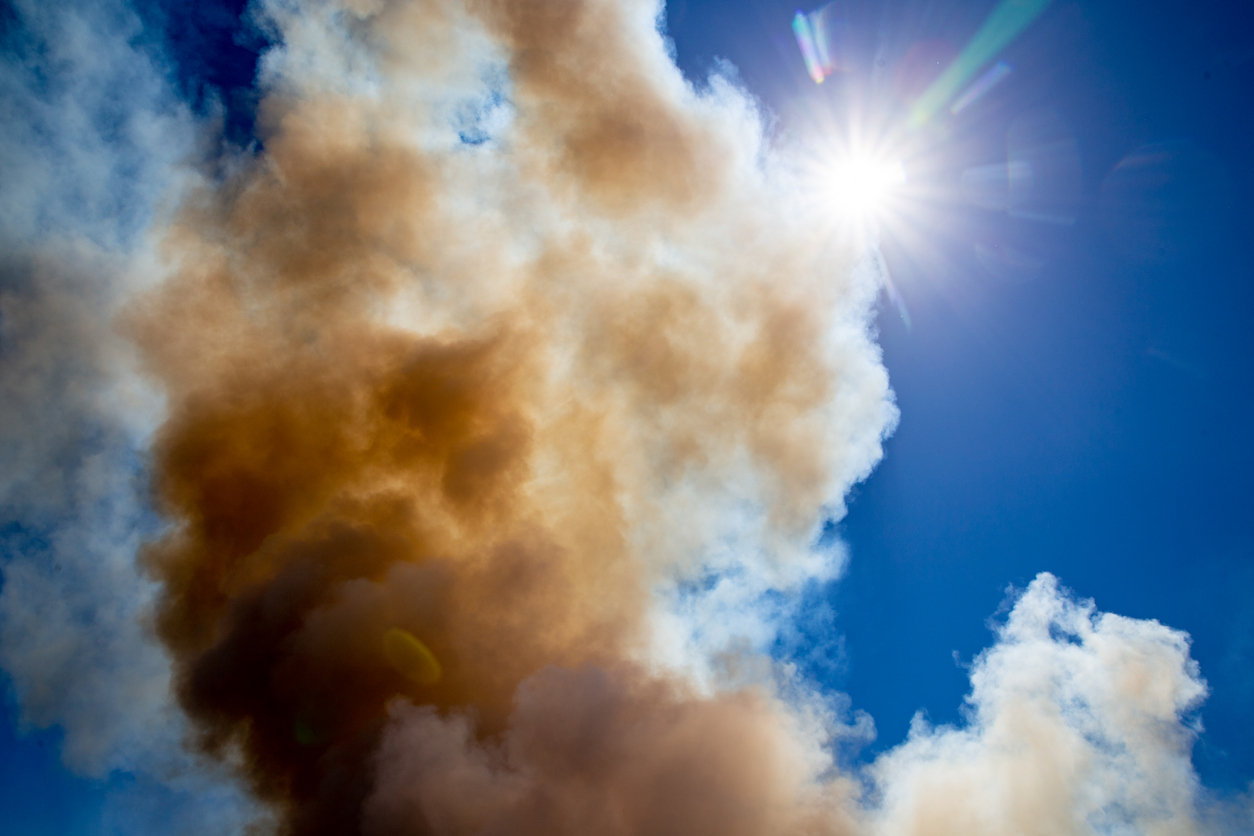
As forests and agricultural fields burn, they release tiny smoke particles call biomass burning aerosols.
As scorchingly high temperatures and dry conditions fuel devastating wildfires across North America and Europe, additional smoke is rising from southern Africa. There, vast plumes of airborne particles fill the sky—not from uncontrolled wildfires, but from intentional fires used as a widespread land management technique.
While the immediate destruction of erratic wildfires dominates global headlines, atmospheric scientists are finding that these controlled agricultural burns release a steady stream of smoke that alters the atmosphere in ways our current climate change models still struggle to predict.
As forests and agricultural fields burn, they release tiny smoke particles called biomass burning aerosols, or BBA. These particles interact with sunlight and clouds to either heat up the planet by absorbing sunlight or cool it down by reflecting it. This is known as the particles’ radiative effect, and different computer models disagree on how much the particles are actually heating or cooling the Earth.
Researchers at Carnegie Mellon University’s Center for Atmospheric Particle Studies investigated these inconsistent predictions about the radiative effect of BBA. Their findings were published in a paper titled “Strong sensitivity of simulated biomass burning aerosol transport and radiative effects over the South Atlantic to carbonaceous aerosol aging and particle density” in the Journal of Geophysical Research: Atmospheres.
The study was led by Kate Johnson, a Department of Civil and Environmental Engineering Ph.D. candidate at Carnegie Mellon University.
The researchers compared a major climate simulator called the Unified Model, primarily developed by the UK’s Met Office, against real-world, physical data. This data was gathered during two aircraft research campaigns that flew directly through wildfire smoke over the Southeast Atlantic Ocean in the summer of 2017. CMU’s Hamish Gordon, an associate professor of Chemical Engineering, was onboard some of the flights to help the team understand the data as it was being collected in real time.
The team specifically isolated and tested three highly precise properties of smoke that models usually oversimplify: oxidative aging, refractive index, and particle density. They discovered that changing the math formulas completely altered the model's climate predictions.
When they applied their new chemical aging formula, it successfully matched real-world data regarding how smoke changes as it gets older, but it barely changed the overall heating effect on the planet. When they changed the density of soot (black carbon), the smoke absorbed more sunlight. This caused an increase in the heating effect on the surrounding air and resulted in black carbon self-lofting, where the smoke lifts itself higher into the atmosphere and travels further across the ocean. Another formula change lowered the density of the organic particles to match realistic values, which counteracted the heating effect.
In the prediction models, all of these changes impacted the way smoke blocks or absorbs sunlight more than they impacted how the smoke changed the behavior of surrounding clouds. Notably, some changes led to better agreement of the simulations with the data collected by the aircraft.
“This research demonstrates that seemingly minor tweaks to global climate models can have balance,” said Gordon, who managed the project. “Better understanding of what the models are sensitive to can provide for better planning and policy making.”
Collaborators on this work included scientists from the University of Miami, Brookhaven National Laboratory, Leibniz Institute for Tropospheric Research (Germany), Max Planck Institute for Chemistry (Germany), and the Met Office Hadley Centre (UK).
For media inquiries, please contact Lisa Kulick at lkulick@andrew.cmu.edu