
The transport phenomena behind products you use every day
Lauren Smith
Sep 18, 2025
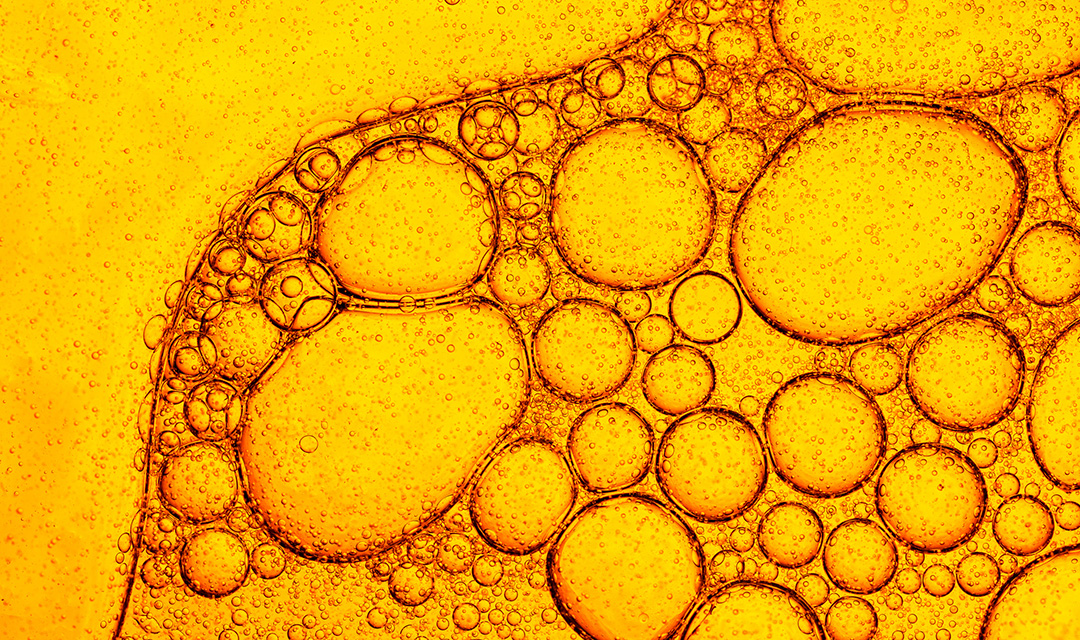
From shampoos to stain removers, many consumer goods need to deliver an agent to an oily space or remove an oil. Increasing mixing at oil/water interfaces can increase the rate of transport and improve product performance.
Researchers at Carnegie Mellon University are helping The Procter & Gamble Company (P&G) understand transport phenomena in complex fluids. Fundamental science, like that of oil/water emulsions, determines how well consumer products work.
Robert Tilton, Stephen Garoff, Aditya Khair, and their students recently discovered a new type of instability in multiphase fluid systems, like oil and water. In Industrial & Engineering Chemistry Research, they describe spontaneous mixing at the interface when two fluids come into contact.
The findings have potential application to personal care products, cleaning products, and oil spill cleanup. The Department of Chemical Engineering works with P&G for fundamental studies that help guide product formulation. Although ChemE researchers are not directly formulating products, "we often sit around a table with our P&G colleagues brainstorming new experiments to try," says Tilton, Chevron professor of chemical engineering.
Tilton has long been interested in how the complex mixtures in formulated fluid products alter fundamental mechanisms to create the function of each product. "There are strong interactions between the different components of the fluids, and the mechanisms we're studying end up being completely different when we have a mixture as opposed to a single system," says Tilton.
Many of these transport phenomena are well-understood in simple solutions but not in the complex fluids that are relevant to industrial practice. Diffusiophoresis, for example, is a process by which dispersed colloidal particles move in solutions that have a concentration gradient of some molecular solute. "It can be a really potent transport mechanism, especially for getting particulate active agents into porous spaces," says Tilton. It is distinct from diffusion, in which particles migrate in response to their own concentration gradient, from regions of high concentration to regions of low concentration. During diffusiophoresis, it's as if the particles are sensing a concentration gradient of some other solute. The strength of those interactions provides energy that moves large colloidal particles much faster than with diffusion.
It can be a really potent transport mechanism, especially for getting particulate active agents into porous spaces.
Robert Tilton, Chevron Professor, Chemical Engineering
The performance of many consumer products depends on the motion of colloidal particles in porous spaces, whether on the skin or in the fabric of clothing. For these applications, diffusiophoresis needs to happen in a chemically complex environment.
Research from Tilton, Garoff, and Khair has deepened the understanding of how diffusiophoresis works in a complex fluid, which can have both polymers and surfactants in solution. With hydrophobic and hydrophilic parts, surfactants decrease surface tension between two liquids. In personal care product formulations, surfactants are at concentrations at which they routinely self-assemble into clusters of 60-70 molecules, called micelles.
"The influence of an individual surfactant molecule on diffusiophoresis is quite different from the influence of a micelle," says Tilton. In Langmuir, Tilton and collaborators showed how micelles contribute to the direction and magnitude of diffusiophoresis.
The situation is even more complex in formulated products. Surfactants can also bind to polymers that are often in solution with them, forming unique structures that behave differently from individual surfactant molecules and from micelles.
Tilton, Garoff, and Khair studied the role of polymer-surfactant binding and the potential to control the rate at which particles move by diffusiophoresis. In the Journal of Colloid and Interface Science, they showed ways in which that binding can sustain diffusiophoresis over larger distances, enhancing transport.
"The potential ramifications of that are interesting whether you need to deliver an active agent or remove a contaminant," says Tilton. "You can design the gradients so that you have a greater chance of getting a particle into a porous space or, going the other direction, of getting a particle out."
In the current study with P&G, Tilton is investigating transport of oils in foams. Many consumer products, from skin cleansers to dish detergents, do their job using the properties of foams.
The Department of Chemical Engineering has brought both experimental and computational expertise to its 12-year collaboration with P&G. "By combining experimentation and theoretical modeling, we can take our projects farther," says Tilton. Learning to communicate across specialties also prepares students for what they'll find in industry, where teams often bring together experimentalists and theorists.
For media inquiries, please contact Lauren Smith at lsmith2@andrew.cmu.edu.